
You've found the perfect gulet, agreed on the charter fee, and then the contract mentions APA. Suddenly there's an extra allowance on top of everything you've already budgeted. If this sounds familiar, you're not alone. APA — Advance Provisioning Allowance — catches first-time charterers off guard more than almost anything else in the booking process.
Here's the thing: APA isn't a hidden fee or a trick. Once you understand how it works, it actually gives you more control over your holiday spending than most alternatives. This guide covers everything you need to know about APA yacht charter Turkey bookings — from what the allowance covers to how to get unspent funds back.
Quick note for Turkey: Not every Turkish gulet charter uses APA. Many gulets operate on a full-board / included-expenses model where items like meals, fuel, mooring and Turkish port procedures may already be included in the charter fee (your contract will state this). APA is most common on “plus expenses” (often MYBA-style) bookings and some higher-end charters.
What Is APA in a Yacht Charter?
Understanding what is APA yacht charter is the first step to budgeting your Turkey trip accurately. Think of APA as the captain's petty cash fund. Before your charter begins, you transfer a set amount — typically 25–35% of the base charter fee (and on some charters, depending on yacht type/route, it can approach ~40%) — to the operator/captain as specified in your contract. The captain then uses this fund to pay for all running expenses during the trip: fuel, food, port fees, mooring dues, and similar costs.
This is the advance provisioning allowance explained in its simplest form: you pre-fund the trip's operating costs, the captain manages the spending, and anything left over comes back to you at the end.
Turkey's charter routes make APA particularly relevant on “plus expenses” itineraries. The Turkish Riviera can involve significant motoring — especially on routes running from Göcek to Marmaris or Bodrum to Datça. Fuel costs here aren't trivial when fuel is not included. A 7-day route with daily engine use can consume roughly €500–€1,500 in diesel alone, depending on vessel size, engine/generator hours, and conditions.
Without APA, operators would either inflate the base charter price (guessing at fuel use) or leave clients scrambling for payments mid-voyage. APA solves both problems cleanly.
Budgeting Your Gulet Charter?
Get a clear breakdown of APA and charter costs. We'll send you our complete budgeting guide for your Turkish cruise.
How Much APA Do You Usually Pay?
The standard APA percentage — most commonly 25 to 35 percent (sometimes higher on fuel-heavy or higher-end charters) — reflects real differences in route intensity and group behaviour. Use the lower end for shorter, lower-activity itineraries and the higher end for longer or more active ones. On a €10,000 charter fee, that's €2,500–€3,500 set aside before you board (and on some charters it may be closer to €4,000).
What drives the number higher or lower:
- Route length and motoring distance — Bodrum to Knidos and back burns more fuel than anchoring near Göcek's 12 islands for a week
- Group size — More guests means more provisioning costs
- Dining preferences — A group eating every meal onboard spends significantly more than one that dines ashore most evenings
- Season — Peak July–August brings higher marina fees and busier anchorages with generator demand
| Expense Category | Typical Weekly Range |
|---|---|
| Fuel & generator | €400–€1,500 |
| Food & beverages | €700–€2,200 |
| Port & mooring fees | €200–€900 |
| Water, ice, supplies | €100–€350 |
| Harbour dues & taxes | €100–€400 |
One contrarian point worth making: most charter advice tells you to budget ~30% as a safe middle ground, but experience shows that food and beverage costs are consistently underestimated. If your group drinks wine with dinner and enjoys fresh seafood, budget closer to the upper end — you'll likely use most of it.
APA is paid in euros in most cases, transferred before departure either via bank transfer through the agency/operator (most common) or as otherwise specified in your contract. Timing varies by operator — many require the APA transfer 1–2 weeks before the charter start date, though some arrange it on embarkation day. Confirm this in writing when you sign the contract.

What Does APA Cover on a Turkey Charter?
APA covers fuel, food, and port fees — the three main expense categories that vary by route and group behaviour. Here's how each breaks down in practice.
The provisioning side covers everything the captain purchases to stock the boat before and during the trip: fresh produce, meat, fish, dairy, bread, water, soft drinks, alcohol, snacks, and ice. Some clients hand the captain a detailed shopping list in advance; others trust the crew's judgment on quality and variety.
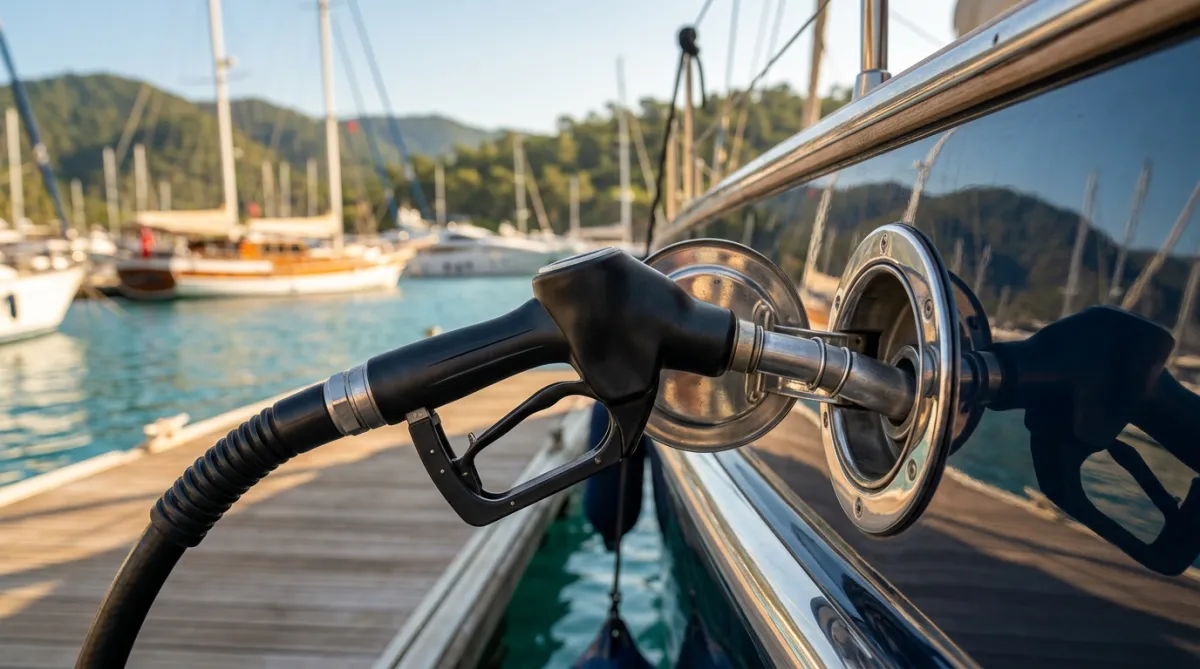
Beyond food, APA covers fuel and generator costs — and this is where Turkey differs from, say, the Greek islands. Turkish charter routes often involve longer passages between destinations. The gulet cruise Turkey experience is built around exploring multiple bays and anchorages, which means the engine runs regularly on distance-heavy itineraries.
Port and mooring fees vary enormously by location. A night in Marmaris Marina during peak season costs significantly more than anchoring in a quiet bay near Bozburun. Port duties, harbour taxes, and local authority fees all come from the APA fund.
What APA does not cover: the crew's gratuity (separate, commonly ~5–15% of the charter fee — more on this below), any personal purchases you make ashore, excursions, or medical expenses. On cross-border itineraries, additional fees/taxes/agents in foreign waters are typically separate and should be confirmed in your contract.

Is APA Refundable If Not Used?
Unused APA is returned to you at the end of the charter. This is a critical point that separates APA from a flat "all-inclusive" fee — you only pay for what's actually spent.
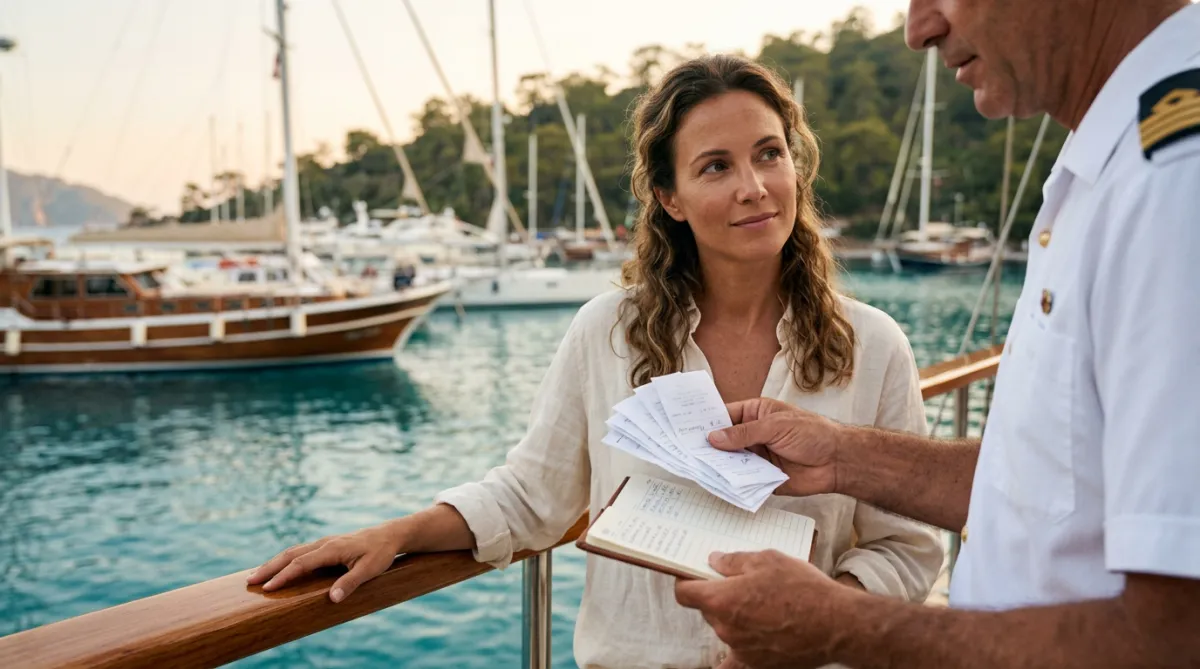
The captain keeps receipts for every purchase. On a well-run charter, you'll see a mid-week spending summary and a full settlement on the final day. If €400 remains unspent, it comes back to you in cash or is credited back through the agency (depending on how APA was paid).
This transparency is also where disputes occasionally arise. Charter operators rarely mention this upfront, but you have every right to review all receipts before settlement. If a receipt looks unclear or a line item seems high, ask. Good captains expect it and come prepared.
The flip side: if APA runs out before the charter ends — which happens with larger groups or longer routes — you top it up. This is called an APA top-up, and it should be outlined in your contract.
How to Track APA Spending Onboard
The best approach is to set expectations on day one. Ask the captain for a simple daily or every-other-day expense update. Most experienced captains on blue cruise Turkey itineraries already do this, but not all.
A few practical habits that help with budget control:
- Agree on a provisioning budget per person per day before departure (€40–€70/person/day is a reasonable range for food and beverages)
- Ask to see the marina fee receipts when you arrive at each port
- Request a running total at the midpoint of the trip
- Clarify whether alcohol is included in provisioning or tracked separately
If you're chartering through an agency, ask them to specify the APA policy in writing — what it covers, the receipts requirement, and the settlement process. This avoids misunderstandings on the last morning when everyone's tired and ready to get home.
APA vs. Full-Board: Which Works Better for Turkey?
Some gulet charter options — particularly on the Turkish coast — offer full-board packages instead of APA. Full-board means food and sometimes fuel are included in the base charter price, with no separate fund to manage.
Full-board sounds simpler, and it is. But the trade-offs are real. Provisioning quality is often standardised across the fleet. Menu flexibility is limited — you can't easily request a lobster night or adjust for guests who want to eat ashore in Göcek. And crucially, full-board pricing is typically built around average consumption, which means light eaters and drinkers subsidise heavier ones.
On comparable vessels, full-board packages often cost more than the base charter fee — without the flexibility APA provides. With APA, a group that dines ashore three evenings and anchors in free bays may return unspent funds. That saving usually disappears with full-board.
We recommend APA over full-board for most “plus expenses” Turkey charters, especially groups of 6 or more with varied preferences. The transparency and flexibility outweigh the simplicity of a flat package. Full-board makes more sense for shorter 3–4 day mini cruise itineraries where provisioning complexity is low and the group has uniform preferences.
For family yacht charter groups with children, APA also allows the captain to tailor provisioning to specific dietary needs — something a standardised full-board menu can't easily accommodate.
A Realistic Total Cost Breakdown
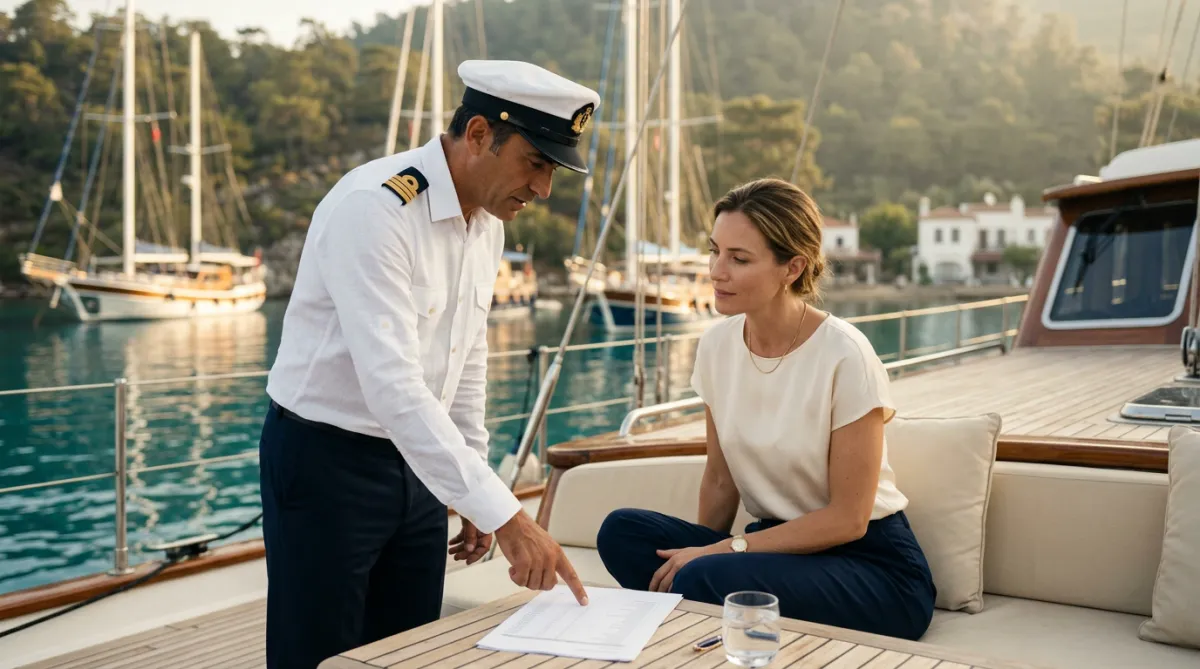
Here's where many first-timers get caught out: APA is only part of the total trip cost. Let's take a concrete example — a €10,000 base charter, 8 guests, 7 days, Göcek to Marmaris — and map out the full picture:
| Cost Item | Estimated Range |
|---|---|
| Base charter fee | €10,000 |
| APA (30–35%) | €3,000–€3,500 |
| Crew gratuity (typical guidance) | €500–€1,500 (varies) |
| Personal spending ashore | €400–€800 per person |
| Total trip cost (excl. flights) | €13,500–€15,000 + personal |
Crew Gratuity: What You Should Know
Crew gratuity is separate from APA. The common guidance range is 5–15%, with ~10% often used when service is strong — roughly €1,000 on a €10,000 charter. Treat it as a real budget line item, but remember the final amount should reflect service quality and your agency’s/local norms guidance.
Tip at the lower end (5–7%) for adequate service that meets expectations. Offer around 10% for attentive, professional crew work. Go higher (12–15%) if service exceeds expectations — the crew reads your satisfaction immediately, and a generous tip builds goodwill onboard. Don’t tip from the APA fund unless your contract explicitly allows it; gratuity is usually handled as a separate transaction at the end of the charter.
This breakdown is what you should leave this section with: APA is roughly a quarter to a third of your total spend, not an add-on to ignore. Combined with crew gratuity, you're often looking at roughly 35% above the base charter fee before personal spending begins.
Pro Tips Before You Sign
Specify your provisioning preferences in writing before the charter starts. Don't assume the captain knows your group drinks only sparkling water or that two guests are vegetarian. The more detail you provide upfront, the more accurately the captain can provision — and the less likely you are to hit an unexpected top-up request.
Ask for a mid-week APA report as a contract condition. Not every captain offers this voluntarily, but most will agree if it's written in from the start.
Budget APA as a real cost, not a deposit. Many first-timers mentally treat APA as money they'll get back. Some of it comes back — but plan to spend most of it. A realistic week on a luxury gulet charter in Turkey for 8 guests, with good food and active motoring, can consume most of a standard APA fund.
Pre-Charter APA Checklist
- Confirm the receipts policy is written into your contract
- Set a provisioning budget per person per day in writing before departure
- Request a mid-week spending report as a contract condition
- Clarify gratuity expectations with your agency before boarding
- Ask whether APA is paid to the operator/agency or handled onboard — and confirm the timing
When comparing operators, look for agencies that publish their APA policy clearly and offer itemised settlement reports. Transparent operators welcome receipt reviews; less professional ones resist them. That reaction alone tells you a lot about who you're chartering with.
The APA system rewards engaged charterers. The more clearly you communicate your preferences and the more actively you track spending, the better the experience — and the fewer surprises on settlement day.
References
- MYBA (Charter contracts & APA guidance)
- Dockwalk: The ABCs of the APA
- Boat International: APA definition (nautical terms)
- Boat International: Charter tipping guidance
This article was published on February 27, 2026.
I have over ten years of experience in luxury yacht charters. I focus on creating amazing sailing experiences along the Turkish Riviera. As the CEO of De Yachting since 2010, I have managed many successful charters. I know Turkey's most beautiful coastal spots very well.
Areas of Expertise
Have questions about yacht chartering?
Feel free to reach out directly